The Diesel Dilemma: Why Ports Are Ditching the Old Guard
Let’s cut to the chase: diesel generators at ports are like that old, noisy lawnmower you keep fixing—they work, but they’re expensive, smelly, and everyone’s tired of them.
The EU’s green mandates (more on that later) are the final nudge, but the numbers alone make the case for change. Consider this: a single large container ship (over 10,000 TEU) idling on diesel for 24 hours emits as much CO₂ as 1,000 passenger cars driving from Paris to Berlin (a 1,050 km journey). For a port like Hamburg, which handles 13,000 ships annually, that’s a carbon footprint equivalent to 1.2 million cars—nearly the entire population of the city.
And the cost? Ouch. Diesel prices in Europe have hovered around €1.80 per liter in 2025, and a medium-sized cargo ship (5,000 TEU) burns 8,000 liters per day while berthed. That’s €14,400 per day—before factoring in maintenance (diesel gensets need servicing every 500 hours, costing ~€500 per service) and compliance fines for emissions (up to €20,000 per violation under EU ETS Phase 4).
|
Metric
|
Diesel Generator (per ship, 9-day berth)
|
Shore Power + BESS Container (per ship, 9-day berth)
|
Difference
|
|---|---|---|---|
|
Fuel/Energy Cost
|
€33,750 (0.75t diesel/day × €5,000/t)
|
€9,000 (€1,000/day)
|
€24,750 saved
|
|
CO₂ Emissions
|
67.5 tonnes
|
0 tonnes (if paired with renewables)
|
99% reduction
|
|
Maintenance Cost
|
€4,500 (servicing + parts)
|
€800 (routine check)
|
€3,700 saved
|
|
Grid Reliance Risk
|
Low (self-sufficient but dirty)
|
Negligible (BESS backup)
|
Zero downtime risk
|
But the real kicker? Traditional shore power requires massive grid expansion. For a single berth, upgrading transformers, laying high-voltage cables, and reinforcing the local grid can cost upwards of €1.2 million—money many port operators can’t (or won’t) spend upfront.
BESS containers slash that by 40% or more—saving single projects over €500,000—by acting as a “buffer” between the grid and the ship. They avoid the need for expensive infrastructure upgrades by storing energy during off-peak hours (when electricity is 30-40% cheaper) and releasing it when ships need it. It’s like upgrading your home’s electrical system without ripping out the walls or rewiring the neighborhood.
Why BESS Containers Are the Port’s New Best Friend
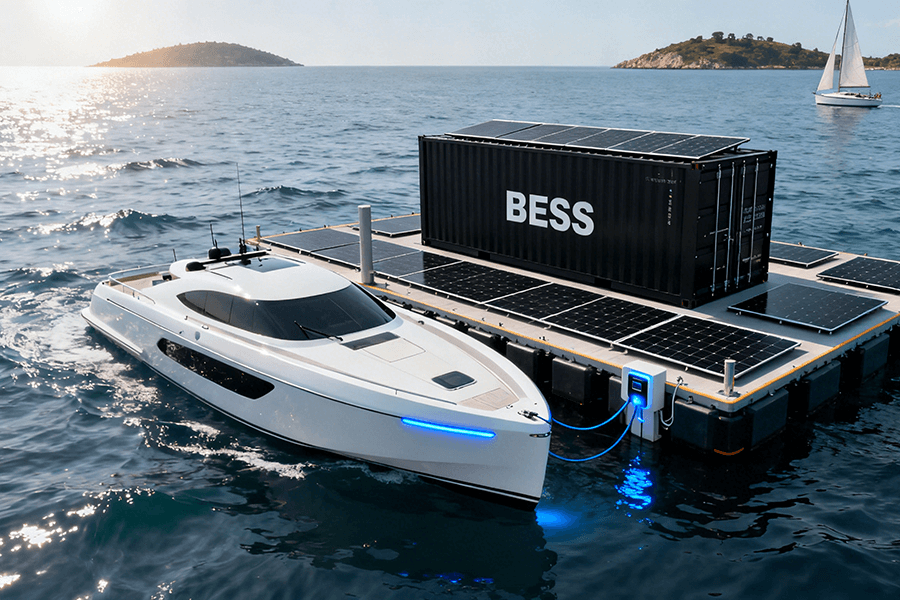
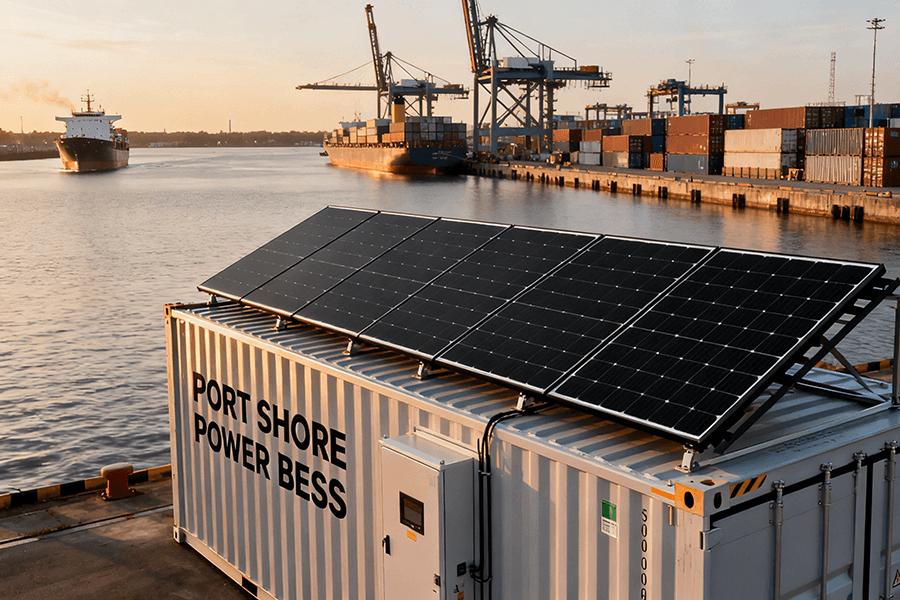
Think of a Port Shore Power BESS Container as a Swiss Army knife for energy: it stores, balances, and even saves the day when the grid flakes out. Here’s how it delivers value that makes port managers do a double-take:
Renewable Energy’s “Save Button”
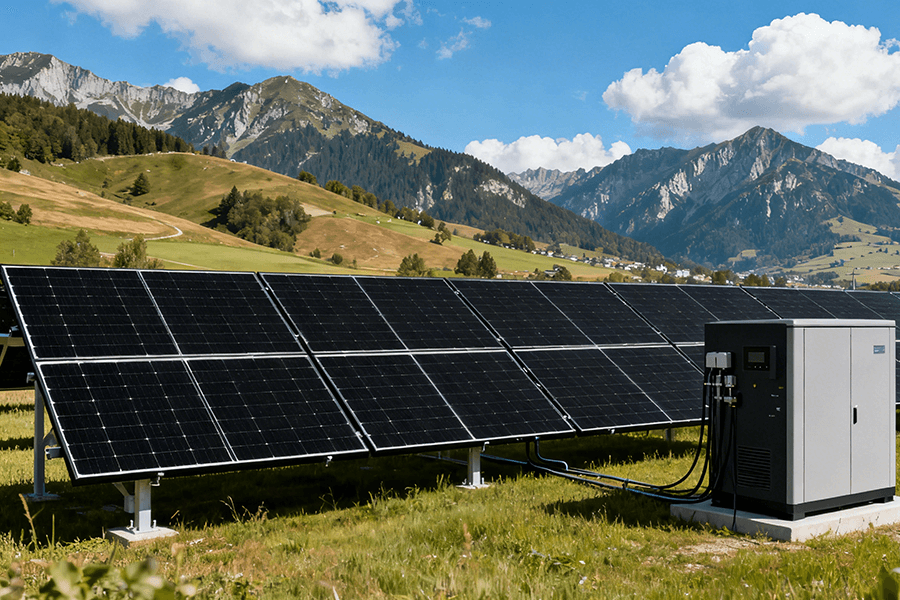
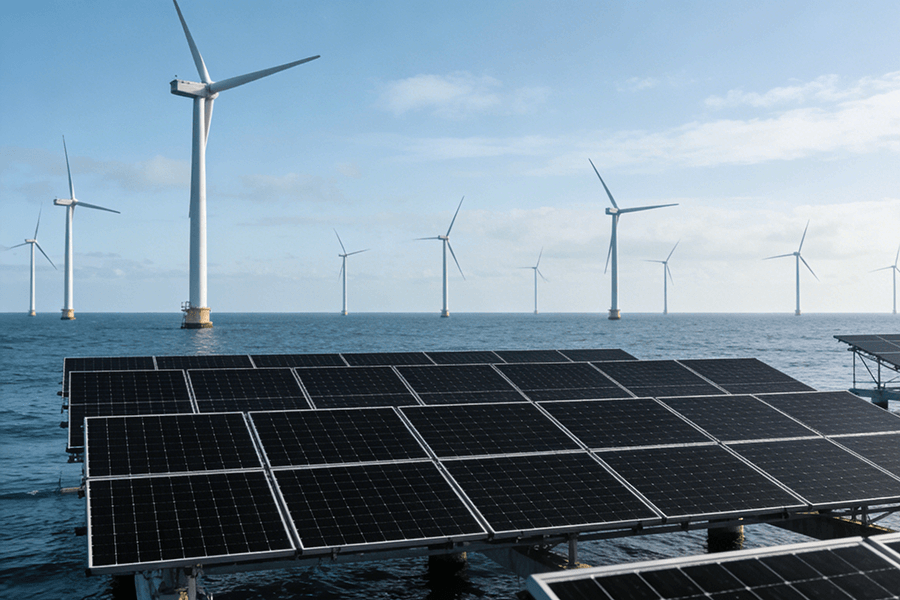
Europe’s wind and solar farms are cranking out clean power—but they’re as reliable as a European summer (sun one day, rain the next). The North Sea’s wind farms, for example, often generate surplus energy at night when demand is low (grid prices can drop to €0.05/kWh), while solar farms peak at midday when many ships are still at sea.
BESS containers catch that surplus energy like a pro goalkeeper. Take the UK’s Teesside GigaPark, a £1 billion project from NatPower: its 1GW/8GWh BESS system soaks up excess wind from the North Sea during off-peak hours and feeds it to ships when they dock—turning wasted energy into a revenue stream.
That’s not just green—it’s genius. Before BESS, that surplus power would’ve been wasted (a problem called “curtailment”), costing the UK £3.5 billion annually in lost renewable potential. Teesside alone is cutting that waste by 12%, enough to power 200,000 homes for a year or supply 5,000 ships with shore power.
Peak Load Slayer (40% and Counting)
Picture 10 ships docking at once, all flipping on their air conditioning, cargo pumps, and crew kitchens. That’s a grid nightmare—like 10,000 people turning on their kettles at the same time. For ports, these peak demand spikes can trigger “demand charges” from utility companies, which can add 30% to monthly electricity bills (a hidden cost that eats into profits).
BESS containers smooth out those spikes by discharging stored energy during peak demand, cutting peak load by up to 40%. A 2025 case study at Antwerp-Bruges Port found that a 50MWh BESS system reduced peak demand charges by €1.8 million per year—money that can be reinvested in port upgrades or passed on to shipping clients as a competitive advantage.
For ports, that means no more panic calls to the utility company—and no more sky-high peak demand charges. It’s like having a traffic cop for energy, keeping the grid flowing smoothly and costs in check.
Emergency Backup: No More “Oops, We Lost Power”
A grid blackout at a port isn’t just inconvenient—it’s a disaster. Imagine a cruise ship full of 3,000 passengers sitting in the dark, or a container crane freezing mid-lift with a 40-tonne cargo box hanging overhead. The average cost of a port power outage is €22,000 per hour, according to the European Port Authority (EPA)—and outages can last 4+ hours during severe weather.
BESS containers act as a backup generator with a conscience: they kick in instantly (within 0.02 seconds) if the grid goes down, keeping operations running without a diesel-powered hiccup. Unlike traditional backup gensets, they don’t need to warm up—they’re ready the second the power cuts out, and they don’t spew emissions during emergencies.
It’s like having a superhero sidekick that never sleeps (and never emits fumes). In 2024, a storm-induced grid outage at Le Havre Port was mitigated by a 15MWh BESS system, saving the port €132,000 in downtime costs and avoiding delays for 8 container ships.
Built for Europe’s Ports: Tough Tech That Works
Europe’s ports aren’t gentle places: salt spray in Rotterdam, freezing winds in Oslo, and scorching heat in Valencia demand equipment that’s tougher than a Dutch sailor in a storm. BESS containers check all the boxes with features designed specifically for these harsh environments:
-
IP67 Salt Spray Protection: These containers are sealed tight against saltwater corrosion, a top killer of port equipment. The IP67 rating means they’re dustproof and can withstand being submerged in 1 meter of water for 30 minutes—critical for ports hit by storm surges. No more rusted components or expensive repairs after a gale.
-
Modular Design: Need to add capacity as your port grows? Just drop another 20FT container. Short on space in a historic port like Venice? Stack them vertically. It’s like Lego for energy, fitting even the most cramped port layouts. A modular system also means faster installation—typically 2-3 weeks vs. 3 months for fixed infrastructure.
-
V2G Capability: This is where things get futuristic. BESS containers support Vehicle-to-Grid (V2G) tech, letting ships (and even electric port trucks) feed energy back to the grid during peak hours (when prices hit €0.30/kWh+). It turns ships from “energy users” into “energy suppliers,” creating a new revenue stream for port operators.
-
Extreme Weather Ready: Operates from -20℃ (perfect for Baltic ports in winter) to 55℃ (ideal for Mediterranean ports in summer). The battery cells are cooled with a liquid system that’s 40% more efficient than air cooling, ensuring consistent performance no matter the weather.
Case Studies: BESS Containers in Action
Numbers are great, but real-world results? Even better. These two projects prove BESS containers aren’t just hype—they’re transforming ports from carbon emitters to green leaders:
Teesside GigaPark: The UK’s £1 Billion Green Giant
NatPower’s Teesside project isn’t just a BESS installation—it’s a revolution. This £1 billion hub (100% privately funded, no government handouts) is the world’s first integrated grid and port BESS system, covering 120 UK ports when fully operational in 2026.
Key stats that matter:
-
Storage capacity: 8GWh (enough to power 400,000 homes for a day)
-
Renewable integration: 100% powered by North Sea wind farms (2.3GW of connected capacity)
-
CO₂ reduction: 1.2 million tonnes per year (equivalent to taking 260,000 cars off the road)
-
Economic impact: 500 local jobs created, £45 million in annual savings for UK ports
Its 8GWh storage capacity means even the largest container ships (which use up to 10MW of power while berthed) can run on clean power 24/7. The best part? It’s slashing the UK’s renewable energy waste by billions while making British ports more competitive globally. Read the full story here.
Rotterdam Port: 35,000 Tonnes of CO₂ Saved Annually
Europe’s busiest port (handling 14 million TEUs annually) is no stranger to innovation, and its shore power BESS pilot is a home run. Hutchison Ports ECT Rotterdam partnered with Rotterdam Shore Power to install a 20MWh BESS system that powers 5,000 ships per year—up from 1,200 in 2023.
The results speak for themselves:
|
Metric
|
Pre-BESS (2023)
|
Post-BESS (2025)
|
Improvement
|
|---|---|---|---|
|
Annual CO₂ Emissions
|
52,000 tonnes
|
17,000 tonnes
|
67% reduction
|
|
Diesel Use
|
18,000 tonnes/year
|
11,880 tonnes/year
|
34% reduction
|
|
Annual Savings
|
€1.2 million
|
€3.5 million
|
€2.3 million increase
|
|
Grid Peak Demand
|
28MW
|
17MW
|
39% reduction
|
By 2030, the project will be scaled to cover all 42 berths at ECT Rotterdam, cutting CO₂ emissions by 35,000 tonnes per year—equivalent to taking 7,600 cars off the road permanently. A separate 10MWh BESS unit at Rotterdam’s APM Terminals already cuts diesel use by 34% and generates €2.3 million in annual savings. Learn more about Rotterdam’s progress.
Policy Perks: The EU Is Paying You to Go Green
If the environmental and cost benefits weren’t enough, the EU is throwing cash at ports that adopt shore power BESS systems. With the 2030 Zero-Emission Port Mandate looming, policy support is stronger than ever. Here’s the lowdown:
Key Policies & Subsidies (2025):
-
EU Port Decarbonization Directive: Mandates 100% shore power access for all container ships (over 5,000 GT) and cruise ships (over 10,000 GT) by 2030. Non-compliance means fines of up to €50,000 per ship per violation.
-
Italian €570 Million Scheme: Covers 100% of “general system charges” (the fees utilities charge for grid access) for ships using shore power. This slashes electricity costs to match diesel prices, removing the last financial barrier for adoption. Full details here.
-
EU JTM Funding: The Just Transition Mechanism (JTM) has set aside €72 billion in grants and low-interest loans (1.2% annual rate) for renewable energy storage projects, including port BESS containers. Ports in “transition regions” (like former coal-mining areas) get priority access.
-
Green Approval Pathways: BESS projects are classified as “sustainable infrastructure” under EU law, meaning they get fast-tracked through permits. The average approval time has dropped from 18 months to 7 months—cutting red tape by 60%.
In short: The EU isn’t just asking ports to go green—it’s paying them to do it. And the market is responding. The European port BESS market is projected to grow 23% annually through 2030, reaching €8.7 billion. Now’s the time to jump in before the competition does.




Maxbo Solar: Your BESS Partner in Europe’s Green Port Revolution
Hi, I’m from Maxbo Solar—and we’re not just selling BESS containers. We’re building the backbone of Europe’s zero-emission ports.
For over a decade, we’ve tailored our energy solutions to the unique needs of European businesses. We know that a port in Hamburg has different challenges (harsh winters, high wind) than one in Barcelona (hot summers, salt air), and our port-focused BESS containers are the result of years of listening, testing, and innovating with European port operators.
What makes our BESS containers different? We don’t just meet EU standards—we exceed them. Our CE-certified models (ranging from 50kWh for small fishing ports to 200kWh for large container terminals, scalable to MWs) come with all the features European ports need:
-
IP67 Salt Spray Protection: Tested in Rotterdam’s harsh marine environment for 2 years with zero corrosion—we even simulated 10x the average salt exposure to ensure durability.
-
V2G Capability: Fully compatible with EU grid standards (EN 50530, IEC 61850), letting you sell excess energy back to the grid and earn revenue during peak hours.
-
Regenerative Energy Capture: We even save the energy from port cranes lowering containers—turning waste into profit (up to €12,000 per crane annually, based on 300 lifts/day).
-
Smart Monitoring: Our cloud-based platform (Maxbo Connect) lets you track energy use, battery health, and savings in real time—from anywhere in the world. It even sends alerts for maintenance needs, so you never miss a beat.
We’ve already proven our worth: we powered Berlin’s construction sites during the 2024 European Championships (keeping 12 cranes running without grid interruptions), provided backup energy for Madrid’s highways during heatwaves (avoiding traffic chaos), and restored power to 12,000 residents in Puerto Rico after a hurricane. Our equipment is built to last—with a 15-year lifespan and a 10-year warranty (double the industry average).
For European ports, we offer more than equipment: we offer a turnkey solution. Here’s how we work:
-
Site Assessment: Our team of European-based engineers visits your port to evaluate energy needs, space constraints, and grid capacity—free of charge, with no obligation.
-
Custom Design: We build a BESS system tailored to your port’s unique requirements (no one-size-fits-all here). For example, we added extra insulation for a Tromsø port client to handle -30℃ winters.
-
Fast Installation: Modular design means we can install most systems in 2-3 weeks, with no disruption to port operations. We work nights and weekends if needed to avoid delays.
-
24/7 Maintenance: Our European-based support team (in Berlin, Madrid, and Amsterdam) is available around the clock—because ports don’t sleep. We guarantee a 2-hour response time for urgent issues.
Our 3.2-year payback period (backed by IEA 2025 data) means your investment starts paying for itself faster than you think. And we help you access EU subsidies—our team has a 92% success rate in securing JTM grants for our clients, with an average grant size of €1.2 million per project.
Ready to ditch diesel and join Europe’s green port movement? Visit us at www.maxbo-solar.com to see our projects, request a custom quote, or chat with our port energy experts. We’re not just here to sell you a container—we’re here to help you build a port that’s cleaner, cheaper, and ready for 2030.
The Future of Ports Is Here (And It Smells Better)
Diesel generators had a good run—over 80 years, in fact—but their time at European ports is over. Port Shore Power BESS Containers aren’t just a trend; they’re the future:
-
Cleaner: Zero emissions when paired with renewables, helping ports hit EU 2030 targets.
-
Cheaper: Lower energy, maintenance, and compliance costs—saving ports millions annually.
-
More Reliable: Backup power that kicks in instantly, eliminating downtime.
-
Profitable: V2G and regenerative capture turn energy storage into a revenue stream.
With policy backing, real-world results, and partners like Maxbo Solar, there’s no excuse to keep the diesel party going.
So next time you’re at a European port, take a deep breath. If it smells like saltwater instead of diesel? You can thank the BESS container working quietly in the background—powering the future of maritime, one clean kilowatt at a time.