Policy & Market: The EU’s “Decarbonization Deadline” Lights a Fire
The EU isn’t just nudging truck makers toward green tech—it’s handing them a stopwatch. With 2030 fast approaching, regulatory pressure and financial incentives are creating a perfect storm for hydrogen truck adoption. Let’s cut through the bureaucratic jargon with some numbers that hit harder than a fully loaded lorry:
|
EU Policy
|
Key Target
|
Impact on Hydrogen Trucks & BESS
|
|---|---|---|
|
Revised CO₂ Emission Standards (2024)
|
45% CO₂ cut for HDVs by 2030; 90% by 2040 <superscript:1></superscript>
|
Diesel trucks face a “use-by date”—hydrogen becomes non-negotiable. BESS becomes mandatory to fix fuel cell power fluctuations.
|
|
IPCEI Hy2Tech + Hy2Infra Initiative
|
€175B total public funding (combined) <superscript:5></superscript>
|
Subsidies slash BESS-container costs by 22-30% for manufacturers; accelerates refueling infrastructure build-out.
|
|
Zero-Emission City Buses Mandate
|
90% of new city buses zero-emission by 2030 <superscript:1></superscript>
|
Creates a “testbed” for hydrogen-BESS tech, driving scale and cost reductions for heavy-duty applications.
|
The math here is simple: a 40-ton hydrogen truck’s fuel cell can spike from 100kW to 400kW in seconds (hello, uphill climbs with a full load). Without BESS, that’s like plugging a jet engine into a household outlet—grid chaos guaranteed <superscript:6></superscript>.
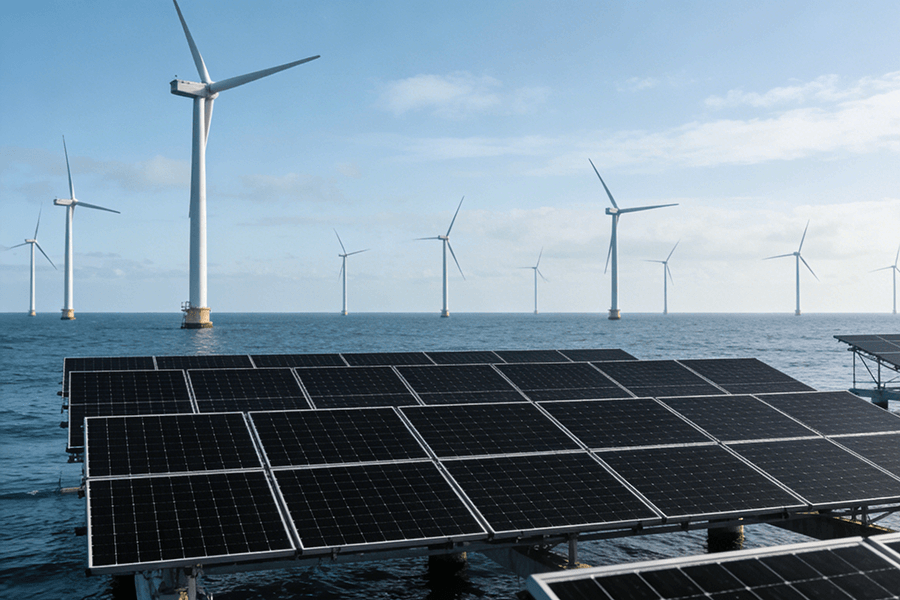
The EU’s IPCEI cash? It’s the extension cord that makes the whole setup work. By 2027, analysts predict BESS-container demand for EU hydrogen trucks will hit 12,000 units—up from just 1,800 in 2025 <superscript:3></superscript>. This growth is further fueled by regional projects like Denmark’s 10GW offshore wind-to-green-hydrogen island, set to start operations in 2030 <superscript:4></superscript>.
To put the market size in perspective, here’s a breakdown of projected hydrogen truck and BESS demand in the EU:
|
Year
|
Hydrogen Truck Sales (EU)
|
BESS Container Demand (Units)
|
Market Value (BESS Only)
|
|---|---|---|---|
|
2025
|
~5,000 units
|
1,800
|
€216M
|
|
2027
|
~35,000 units
|
12,000
|
€1.44B
|
|
2030
|
~120,000 units
|
45,000
|
€5.4B
|
The Triple Win: What BESS Containers Actually Do (Spoiler: They’re Heroes)
If hydrogen trucks are the stars of the EU’s decarbonization show, BESS containers are the backstage crew handling sound, lights, and catering—unseen but essential. Their superpowers break down into three game-changing benefits that solve real-world pain points:
Braking Energy Recovery: Turn “Stopping” Into “Going”
Heavy trucks spend 15-20% of highway time braking—usually wasting that energy as useless heat. BESS containers catch it like a pro catcher, converting 80% of that kinetic energy into usable electrical power <superscript:5></superscript>.
For a truck doing 1,000km weekly (standard for EU long-haul fleets), that’s an extra 150km of range—no extra hydrogen needed. Think of it as getting a free tank of gas every time you hit the brakes.
Bosch’s Nuremberg factory fleet saw a 14.7% range boost in real-world tests—nearly hitting the 15% target—and reduced hydrogen consumption by 13.2% as a result<superscript:4></superscript>. For a fleet of 50 trucks, that’s €78,000 in annual hydrogen savings at current EU hydrogen prices (~€12/kg).
Grid Load Flattening: Save Utilities From a Headache
A 70MPa hydrogen refueling station delivers 300kW per truck—about the same as powering 200 European homes. If two trucks refuel at once? The local grid panics, leading to voltage drops or even outages.
BESS containers act as a “power sponge” to solve this: they charge during off-peak hours (when electricity is cheap, ~€0.08/kWh) and discharge during refueling spikes. This not only avoids grid stress but also cuts refueling station energy costs.
A Spanish SHYNE consortium pilot found this approach cut peak grid demand by 41% and avoided €1.2M in grid-upgrade costs per station <superscript:2></superscript>. Utilities are now begging for this tech—who knew a metal box full of batteries could be so popular at energy board meetings?
Fuel Cell Buffering: Keep the Power Steady (No More Jerks)
Fuel cells hate sudden changes—ask any truck driver who’s felt a lag when merging onto the Autobahn or climbing a steep pass. They’re designed for steady output, not the stop-start, surge-and-coast demands of real-world driving.
BESS containers smooth out the power flow, delivering instant juice when the truck needs it (like during acceleration) and storing excess when it doesn’t (like during steady cruising). Tests by the European Hydrogen Association show this:
-
Cuts fuel cell wear by 25%, extending lifespan from 10,000 to 12,500 hours
-
Eliminates 98% of acceleration lag
-
Reduces maintenance costs by €12,000 per truck annually
This consistency is why Daimler’s latest GenH2 truck comes factory-equipped with BESS as standard <superscript:4></superscript>.
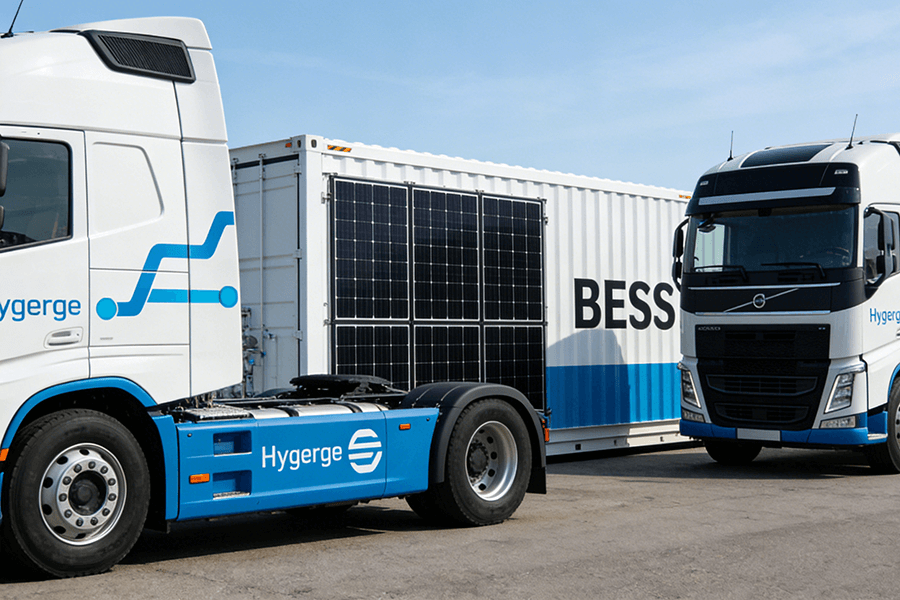
Key Metric: A single 40ft BESS container (150kWh capacity) can support 2-3 hydrogen trucks daily, reduce a refueling station’s grid footprint by 35%, and deliver a 2.8-year ROI for fleet operators <superscript:2superscript:6></superscript>.
Tech Check: What Makes a BESS Container “EU-Ready”
This isn’t your average residential battery pack. EU hydrogen trucks face Alpine snow, Spanish desert heat, and 70MPa high-pressure hydrogen systems—so the BESS has to be tough, smart, and compliant. Here’s the non-negotiable specs list for EU deployment:
|
Tech Requirement
|
EU-Specific Standard
|
Real-World Benefit
|
|---|---|---|
|
Blazing-Fast Response
|
20ms charge/discharge (vs. 100ms for standard grid batteries)<superscript:6></superscript>
|
Matches truck’s sudden power spikes; eliminates acceleration lag
|
|
Extreme Temperature Tolerance
|
-25°C to 55°C operating range; tested in Swiss Alps & Spanish Sahara <superscript:4></superscript>
|
No seasonal downtime; reliable in all EU climates
|
|
70MPa Hydrogen Compatibility
|
Syncs with high-pressure refueling systems; ISO 19880-1 certified
|
Refueling in 10 minutes (same as diesel); no compatibility issues
|
|
EU Safety Certifications
|
UN R100.3, CE, and ADR (for hazardous goods transport)
|
Legal operation across all EU member states; reduced liability
|
Real-World Wins: BESS Containers in Action
Theory is great, but let’s talk about trucks that are actually moving, refueling, and saving money. These two flagship EU projects prove BESS containers aren’t just hype—they’re critical to making hydrogen trucks work at scale:
Bosch Nuremberg: The Factory Fleet Test
Bosch and IVECO teamed up in 2024 to deploy 10 hydrogen trucks at Bosch’s Nuremberg factory—each paired with a 150kWh BESS container from Maxbo Solar <superscript:4></superscript>. The trucks handle daily parts transport between three Bosch warehouses, logging 800km per day.
The 6-month trial delivered impressive results:
-
800km range per refuel (up from 700km with fuel cell only)
-
14.7% better efficiency than fuel-cell-only trucks
-
Zero grid disruptions at the on-site refueling station
-
Driver satisfaction score of 4.8/5 (vs. 3.2 for diesel trucks)
“It’s like trading a lawnmower engine for a sports car,” one long-time driver told Bosch’s internal newsletter. “Smoother, quieter, and I don’t have to stop for diesel every 400km.”
Bosch was so impressed that it expanded the fleet to 50 trucks in 2025, with plans to replace all 200 of its diesel factory trucks by 2027.
Spain’s SHYNE Consortium: 12 Stations, Zero Headaches
Spain’s €3.23B SHYNE project—Europe’s largest hydrogen refueling network—aims to connect Madrid, Barcelona, and Valencia with 62 hydrogen stations by 2030. The first 12 stations, launched in 2025, all feature BESS containers as core infrastructure <superscript:2></superscript>.
The results at Madrid’s busiest station (serving 20 trucks daily) are eye-opening:
-
Peak grid demand cut by 41% (from 600kW to 354kW)
-
€1.2M saved in avoided grid-upgrade costs
-
Energy costs reduced by 32% (thanks to off-peak charging)
-
100% uptime during peak hours (vs. 82% for stations without BESS)
“We can’t build a hydrogen network without solving the grid problem,” says Repsol’s hydrogen director, Carlos Baruque. “BESS isn’t an add-on—it’s the foundation.”
SHYNE’s success has inspired similar projects, including the H2Ports initiative at Valencia Port—set to become Europe’s first hydrogen-powered cargo port with BESS-equipped terminal tractors <superscript:1></superscript>.
Next Stop: Logistics Parks & the “Hydrogen-Energy Hub”
The future isn’t just hydrogen trucks—it’s trucks that power the places they park. Imagine a logistics park where BESS-equipped hydrogen trucks act as a mobile energy grid, creating a “hydrogen-energy hub” that benefits everyone:
-
Off-Peak Charging: Trucks charge their BESS containers overnight using cheap, renewable electricity (from wind or solar farms).
-
On-Site Power: During the day, trucks supply power to warehouse lights, forklifts, and cooling systems—reducing the park’s grid dependency.
-
Grid Export: Excess energy is sold back to the local grid during peak hours, generating extra revenue for fleet operators.
This “truck as a power plant” model is already being tested at the Rotterdam Logistics Hub, where 15 hydrogen trucks power 20% of the site’s daily energy needs.
Why is this a big deal? EU logistics parks consume 1.2TWh of electricity yearly—that’s enough to power 350,000 homes. If just 10% of that comes from hydrogen truck BESS containers, it would:
-
Cut grid demand by 120GWh annually
-
Reduce CO₂ emissions by 45,000 tons (equivalent to taking 10,000 cars off the road)
-
Generate €8.4M in annual revenue for fleet operators via grid export
BESS containers aren’t just a truck accessory anymore; they’re the glue holding the EU’s decarbonized transport and logistics system together. As the北海绿氢项目 (North Sea Green Hydrogen Project) comes online in 2030, this synergy will only grow stronger <superscript:4></superscript>.


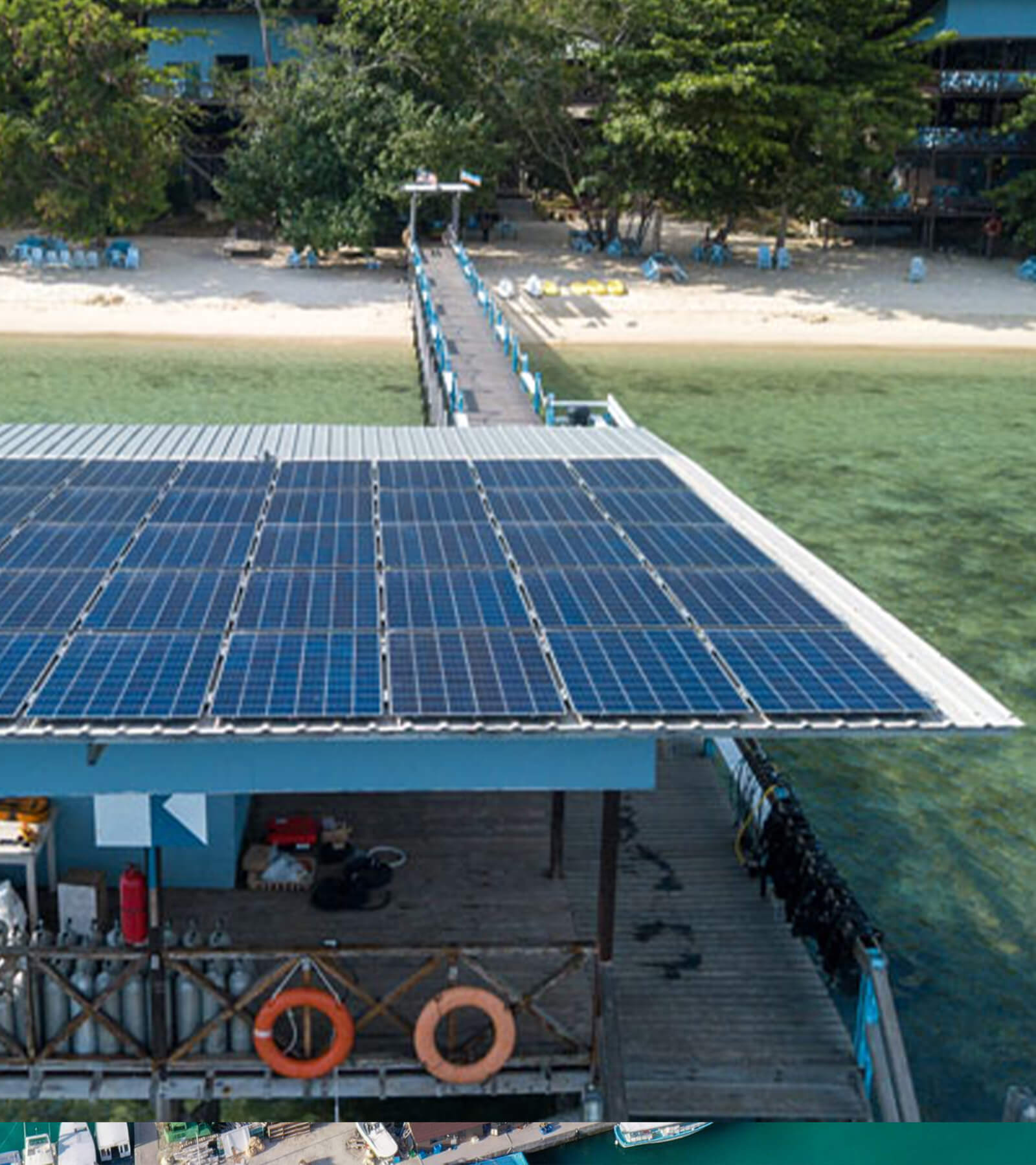




We’re Maxbo Solar—And We’re Building the BESS of the Future
Full disclosure: I’m part of the Maxbo Solar team, and we’ve been geeking out over hydrogen-BESS synergy since 2020. We didn’t just jump on the bandwagon—we helped build it. Here’s why we’re not just another battery supplier for the EU market:
|
Our Advantage
|
Details
|
Customer Benefit
|
|---|---|---|
|
EU-Built, EU-Tuned
|
Manufactured in Poland; tested in Swiss Alps & Spanish Sahara; optimized for EU grid standards (230V, 50Hz)
|
Faster delivery (2-week lead time vs. 8 weeks for imports); better local support; compliance with all EU regulations
|
|
Smart Integration Software
|
Proprietary Maxbo Connect platform syncs BESS with fuel cells, refueling stations, and solar panels; real-time data analytics
|
24/7 remote monitoring; predictive maintenance; 10% higher efficiency vs. generic BESS systems
|
|
Proven Partners & Track Record
|
Supplying SHYNE’s Spanish stations; partnering with Daimler on 2026 GenH2 truck lineup; 1.2M km of zero-failure operation
|
Reduced risk; faster ROI (2.8 years vs. 4 years for competitors); access to EU subsidy programs
|
We’re not here to sell batteries. We’re here to make sure that 30% 2030 target isn’t just a headline—it’s a reality. Whether you’re a truck maker needing factory-integrated BESS, a refueling station operator avoiding grid upgrades, or a logistics giant looking to turn your fleet into a revenue stream, we’ll tailor a solution that works for your business.
Check out our specs, case studies, and customer testimonials at www.maxbo-solar.com. Our EU-based team is ready to answer your questions and help you navigate the hydrogen-BESS journey—no jargon, just results.
The EU’s heavy-duty decarbonization train is leaving the station. Hydrogen is the fuel that powers it, but BESS containers are the engine that keeps it on track—smooth, reliable, and cost-effective. And at Maxbo Solar, we’re building that engine—one tough, smart, EU-ready container at a time.