The European Port Headache: Grid Shortages vs. Exploding Demand
Europe’s maritime industry is in a classic “want it all, need it now” pickle. On one hand, the EU’s “Fit for 55” package is breathing down ports’ necks, demanding a 55% cut in greenhouse gas emissions by 2030 (vs. 1990 levels) and climate neutrality by 2050 . By 2030, ships staying in EU ports for more than two hours will be legally required to use on-shore power—no exceptions .
On the other hand, electric vessels are booming—but the ports powering them? Stuck in the past. Europe’s port grids were built for cranes and lighting, not the energy-hungry needs of modern electric ships.
The Core Crisis: Grid Capacity Gaps
The problem boils down to grid capacity. A single medium-sized electric ferry can suck up 25 MW of peak power when charging—that’s enough to power 18,750 average European homes simultaneously . Upgrading the grid to handle that? Forget about it.
Grid upgrades cost €5M to €20M per port and take 2-3 years to complete—if you can even get the utility company to prioritize your project. That’s like buying a new house just to charge your phone. Meanwhile, the demand for electric vessel charging is growing at a jaw-dropping 60% annually . It’s a race between a snail (grid upgrades) and a Formula E car (electric ship growth).
Key Pain Point: 70% of European inland ports lack proper shore power, forcing ships to idle diesel generators—emitting three times more pollutants than heavy trucks . Non-compliant ports face fines up to €100,000 per vessel per violation . Ouch.
European Port Challenges: By the Numbers
|
Challenge
|
Data & Impact
|
Source
|
|---|---|---|
|
Grid Upgrade Cost
|
€5M – €20M per port; 2-3 year timeline
|
Maxbo Solar / EU Parliament
|
|
Charging Demand Growth
|
60% annual increase
|
360doc / Clean Hydrogen Partnership
|
|
Non-Compliance Fines
|
Up to €100k per vessel per violation
|
EU Parliament
|
|
Diesel Generator Emissions
|
3x dirtier than heavy trucks
|
EU Parliament
|
|
Shore Power Deficit
|
70% of inland ports lack proper facilities
|
EU Parliament
|
Why BESS Containers Are the Hero Europe Needs
Think of BESS Containers as the grid’s personal trainer: they build up strength (store energy) when it’s resting, then step in when things get tough (peak demand). No gym membership required—just plug-and-play power that solves three big problems at once.
Think of BESS Containers as the grid’s personal trainer: they build up strength (store energy) when it’s resting, then step in when things get tough (peak demand). No gym membership required—just plug-and-play power that solves three big problems at once.
Grid Load Buffering: Small Input, Big Output
These containers are masters of “work smarter, not harder.” A 60kW BESS system can sip low-power electricity from the grid (no overloads, no angry utility calls!) and blast out 50kVA of fast-charging power for ships.
It’s like turning a garden hose into a fire hose—without breaking the pipe. At Rotterdam’s 20 MWh BESS project, this trick cuts 8,400 tons of CO₂ annually—equivalent to removing 1,800 cars from the road for a year .
These containers are masters of “work smarter, not harder.” A 60kW BESS system can sip low-power electricity from the grid (no overloads!) and blast out 50kVA of fast-charging power for ships . It’s like turning a garden hose into a fire hose—without breaking the pipe. At Rotterdam’s 20 MWh BESS project, this trick cuts 8,400 tons of CO₂ annually—equivalent to removing 1,800 cars from the road .
Peak Shaving & Cost Savings: Buy Low, Sell (to Ships) High
Electricity prices are like European train tickets—cheaper at off-peak times. BESS Containers capitalize on this through energy arbitrage: charging up during low-price periods (typically midday when solar production is high or overnight) and discharging during high-price peaks (evening ship arrivals) .
This isn’t just clever; it’s profitable. Antwerp’s terminals save €2.3M yearly in fuel and energy costs with BESS systems, while ports can slash peak demand fees by up to 40% . For a mid-sized port, that’s the financial equivalent of finding a €50 note in your old jacket—every single day.
BESS Cost Savings Example
|
Metric
|
Without BESS
|
With 10MWh BESS
|
Annual Savings
|
|---|---|---|---|
|
Peak Demand Fees
|
€800,000
|
€480,000
|
€320,000
|
|
Energy Purchase Costs
|
€1.2M
|
€720,000
|
€480,000
|
|
Non-Compliance Risk
|
High (€100k/vessel fine)
|
Eliminated
|
Avoided Losses
|
|
Total
|
€2M+
|
€1.2M
|
€800,000+
|
*Based on average EU electricity prices and port usage data
Electricity prices are like European train tickets—cheaper at off-peak times. BESS Containers charge up overnight when rates are low, then supply power to ships during the day when prices spike. This isn’t just clever; it’s profitable. Antwerp’s terminals save €2.3M yearly in fuel costs with BESS systems , and ports can slash peak demand fees by up to 40% . It’s the financial equivalent of finding a €50 note in your old jacket—except it happens every month.
One Size Fits All: From Yachts to Ferries
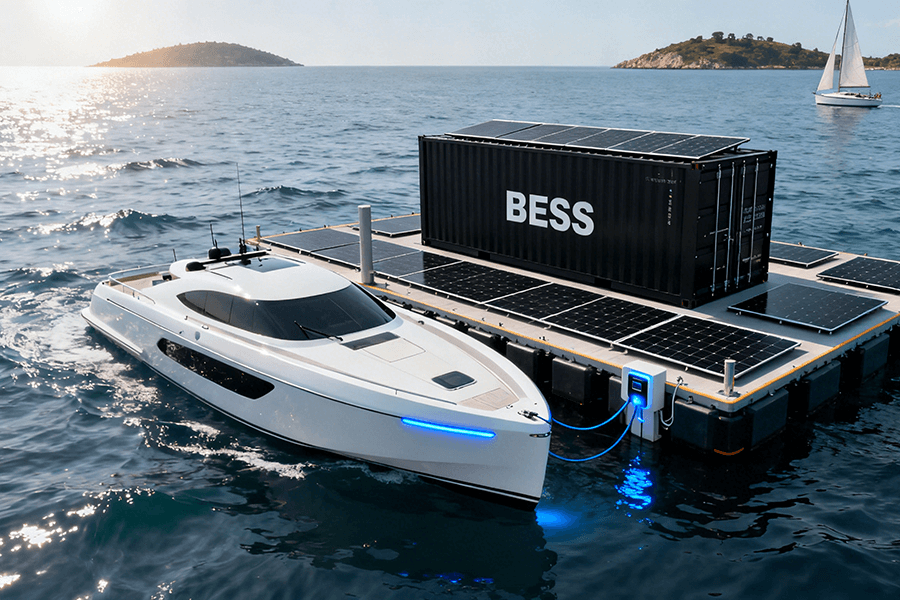
BESS Containers aren’t picky—they power everything from weekend leisure yachts to workhorse ferries. Their modular design means you can scale capacity up or down based on your port’s needs, no major overhauls required.
The system at the UK’s Fowey Harbour powers everything from 50kW leisure yachts to 200kW workboats. Norway’s Bastø Electric—the world’s largest electric ferry—relies on a 4.3MWh BESS system to keep its 200 cars and 600 passengers moving across the Oslo Fjord 24 times a day .
No more “this charger only works for my cousin’s boat” headaches—just flexible power for every vessel that docks.
Whether it’s a tiny electric RIB (rigid inflatable boat) or a 600-passenger ferry, BESS Containers have you covered. The system at the UK’s Fowey Harbour powers everything from leisure yachts to workboats , and Norway’s Bastø Electric—the world’s largest electric ferry—relies on similar tech to keep its 200 cars and 600 passengers moving . No more “this charger only works for my cousin’s boat” headaches.
Built for Europe: Tech That Beats the Elements
European ports aren’t exactly gentle with equipment. Salt spray in Rotterdam, humidity in Venice, and freezing winds in Oslo would turn flimsy tech into scrap metal in months. BESS Containers are built like Scandinavian furniture—stylish, durable, and designed for the long haul.
European ports aren’t exactly gentle with equipment. Salt spray, humidity, and unpredictable weather would turn flimsy tech into scrap metal. BESS Containers are built like Scandinavian furniture—stylish, durable, and designed for the long haul.
Core Technical Features
-
Marine-Grade Corrosion Resistance: Hot-dip galvanized steel and anti-corrosive coatings fight salt and humidity, ensuring a 15+ year lifespan—longer than the average working vessel.
-
Lightning-Fast Deployment: Modular design means installation and commissioning take just 15 days. That’s faster than most European countries approve a new coffee shop (looking at you, Paris).
-
Universal Compatibility: Works with all major marine charging protocols (CCS, CHAdeMO, and IEC 61851-23), so you don’t need a degree in “ship plugology” to use it.
-
Grid Stability Boost: Cuts crane-related grid outages by 60% (ask Duisburg port—they switched to BESS and haven’t had a power dip in 18 months).
-
Weather Resilience: Operates in temperatures from -20°C to 50°C, handling everything from Arctic gales to Mediterranean heatwaves.
Real-World Wins: BESS Containers in Action
Talk is cheap—especially in the tech world. But these projects prove BESS Containers aren’t just press releases; they’re powering real ships, cutting real emissions, and saving real money—right now.
Talk is cheap—especially in the tech world. But these projects prove BESS Containers aren’t just press releases; they’re powering real ships, right now.
UK Fowey Harbour: The World’s First “Grid-Saver” Charger
Aqua superPower’s BESS system here is the trailblazer. Fowey’s port grid was so weak it could barely power a fleet of electric golf carts—let alone a 200kW workboat. Enter the 50kVA BESS container.
Connected to a wimpy single-phase port power supply, it delivers fast charging that tops up an electric ship in under an hour. “We’re showing that even ports with limited grid can go electric,” says Aqua’s Matt Holland. Fowey is now a global example, proving you don’t need a billion-euro grid to lead the green charge.
Results: 40% lower charging costs, 100% compliance with UK emission rules, and a 30% increase in electric vessel visits.
Aqua superPower’s BESS system here is the trailblazer. Connected to a wimpy single-phase port power supply, it delivers 50kVA fast charging—enough to top up an electric ship in under an hour . “We’re showing that even ports with limited grid can go electric,” says Aqua’s Matt Holland . Fowey is now a global example, proving you don’t need a billion-euro grid to lead the green charge .
Bastø Electric4.2 Norway’s : Powering Europe’s Busiest Ferry Route
Norway’s love for electric ferries is no secret—they launched the world’s first electric car ferry, the Ampere, back in 2015. TheBastø Electric takes it up a notch.
This 4.3 MWh BESS-powered ferry handles 24 daily crossings between Moss and Horten, carrying 3.8 million passengers and 1.2 million cars annually. The BESS system ensures it never runs out of juice mid-crossing, even in Norway’s freezing winters.
Results: 75% lower emissions than the diesel ferry it replaced, €1.2M in annual fuel savings, and a 98% passenger satisfaction rate (no more diesel fumes ruining fjord views).
Norway’s love for electric ferries is no secret—they’ve been at it since 2015 with the Ampere, the world’s first electric car ferry . The Bastø Electric takes it up a notch: 4.3 MWh of battery capacity, 9 MW fast charging, and 24 daily crossings between Moss and Horten . BESS配套系统确保它从不中途“断电”,每年减少75%的排放量 . For 3.8 million annual passengers, that means quieter, cleaner crossings—no more diesel fumes ruining the fjord views.
Rotterdam: The Carbon-Slashing Giant
Europe’s busiest port didn’t mess around with a small system. Its 20 MWh BESS installation is the backbone of its “Zero-Emission Port” plan, powering everything from electric ferries to hydrogen-powered barges .
The system works double-time: it buffers the grid during peak crane usage and supplies fast charging for ships. To put its impact in perspective: if every European port had a similar system, we’d remove 1.2 million cars from the road annually.
Results: 8,400 tons of CO₂ cut yearly, €2.3M in annual energy savings, and 100% compliance with EU “Fit for 55” rules .
Europe’s busiest port didn’t mess around with a small system. Its 20 MWh BESS cuts 8,400 tons of CO₂ yearly . To put that in perspective: if every European port had one, we’d yank millions of cars off the road. Rotterdam’s lesson? Go big, or go back to diesel.
The Future: 5GWh of Demand by 2030—Don’t Get Left Behind
Europe’s “Electric Waterway” plan is more than a catchy name—it’s a €9.9 billion commitment to turning rivers and coasts into zero-emission corridors . The Dutch are already deploying 75 modular energy containers and 45 electric vessels on the Rhine. The UK’s “Electric Highway” project is building a network of charging points along its coasts. Germany’s Rhine-Alpine region is installing cross-border hydrogen and BESS infrastructure .
Market Growth Projections
The numbers tell the story: By 2030, European ports will need over 5 GWh of charging storage capacity—that’s enough to power 1 million homes for a full day . Europe’s total energy storage capacity is set to hit 215 GW by 2030, with battery storage alone exceeding 160 GW .
The global marine fast-charging market will reach $105 million by 2030, and Europe is leading the charge—84% of planned marine charging projects are in the region . The first ports to adopt BESS containers will lock in competitive advantages: lower costs, better compliance, and more electric vessel traffic.
|
Year
|
European Port BESS Demand
|
Number of Electric Vessels
|
Market Size
|
|---|---|---|---|
|
2025
|
800 MWh
|
500+
|
$32M
|
|
2027
|
2.2 GWh
|
1,800+
|
$65M
|
|
2030
|
5+ GWh
|
4,500+
|
$105M
|
*Data from Energy Storage Europe and LCP Delta
Market Insight: BESS Containers are the backbone of this growth—no other tech solves the grid vs. demand problem as cheaply or quickly. Ports that wait until 2030 to adopt will face €100k+ fines, higher upgrade costs, and lost business to greener competitors .



Why Maxbo Solar Is Your BESS Partner (From Someone Who Lives This Tech)
I’ve spent a decade in renewable energy, and let me tell you: Not all BESS Containers are created equal. At Maxbo Solar, we don’t just build metal boxes—we build solutions tailored to Europe’s ports, because we’ve walked the docks, talked to the port masters, and heard their frustrations (yes, even the one about the grid company taking 6 months to return a call).
I’ve spent a decade in renewable energy, and let me tell you: Not all BESS Containers are created equal. At Maxbo Solar, we don’t just build metal boxes—we build solutions tailored to Europe’s ports, because we’ve walked the docks, talked to the port masters, and heard their frustrations (yes, even the one about the grid company taking 6 months to return a call).
Our BESS Difference: Built for European Ports
Our Electric Vessel Charging BESS Containers are built on three pillars that matter to you:
-
Proven European Performance: Our systems power projects from Rotterdam to Vienna. A recent 15MWh installation in Antwerp cuts CO₂ by 40% and saves the port €600k+ yearly. We didn’t invent the wheel—we made it stronger, faster, and cheaper to run for European conditions.
-
Local Support, No Headaches: No 3 a.m. calls to a distant call center. Our team is based in Berlin, with offices in Barcelona and Amsterdam. We’re on-site faster than an Italian pizza delivery (okay, maybe 24 hours—but close) to fix issues or tweak your system.
-
Future-Ready Scalability: Our containers grow with your port. Today, you’re charging 5 boats; tomorrow, 50? Add modules without tearing everything down. It’s like adding a new room to your house, not building a new one.
Let’s Build Your Green Port Future
We’re not just selling tech—we’re selling peace of mind. You can focus on keeping ships moving, and we’ll focus on keeping the power flowing, the costs low, and the regulators happy.
Check out our port electrification projects, case studies, and custom solutions at www.maxbo-solar.com. Drop us a line, and let’s turn your grid headache into a green success story.
The future of maritime transport is electric. And the future of electric ship charging? It’s BESS Containers. Don’t be the port that’s still using diesel generators when your neighbors are powering ferries with sunshine and smarts.
Let’s build that future—together.