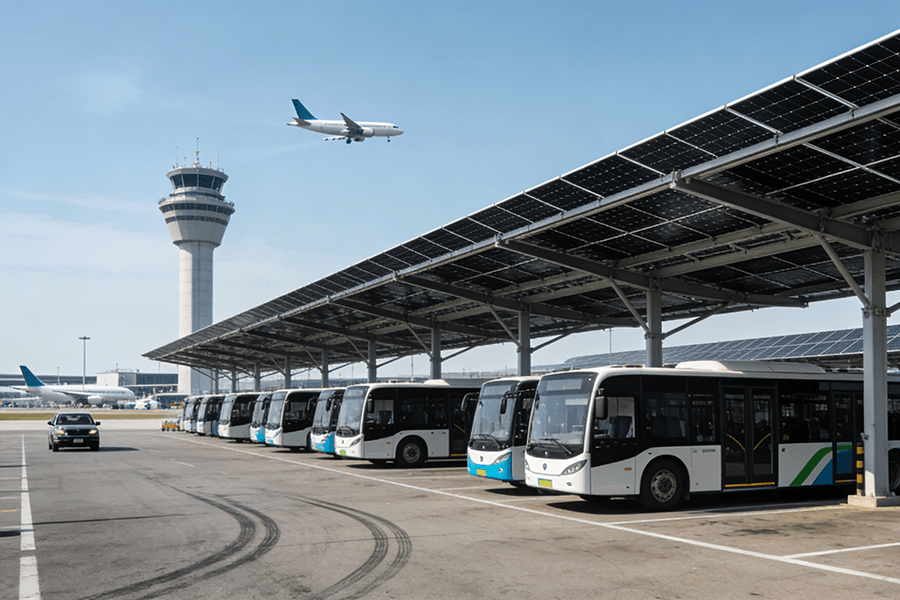
The Clock Is Ticking: Why EU Airports Can’t Afford to Dally
Let’s cut to the chase: the EU’s ReFuelEU Aviation Regulation isn’t a gentle nudge—it’s a legal push that kicked in fully in 2025. This mandate demands 2% sustainable aviation fuel (SAF) this year, ramping up to 5% by 2030 . For airports, the pressure is even more immediate.
Data from ACI Europe (Airports Council International) paints a clear picture: 122 European airports have committed to net-zero ground operations by 2030, and 314 have pledged the same by 2050 . The culprit behind their carbon woes? Ground operations account for 18% of an airport’s total carbon footprint—and diesel GPUs are the single biggest offender.
Imagine this: A single medium-haul aircraft (like an Airbus A320) using a diesel GPU for 4 hours emits roughly 240 kg of CO₂—about the same as driving a car from Paris to Berlin . Multiply that by hundreds of daily flights across Europe, and you’ve got a problem that won’t solve itself with wishful thinking.
The math is non-negotiable: To hit 2030 targets, ACI Europe estimates airports need to replace 70% of their diesel ground equipment by 2028 . BESS containers aren’t just an option here—they’re the fastest, most cost-effective way to check that box.
BESS Containers: The Swiss Army Knife of Airport Decarbonization
Forget one-trick ponies. BESS containers for airports pull triple duty, solving three of the sector’s biggest headaches in one compact, modular package. They’re not just “batteries in a box”—they’re a full-fledged energy management system tailored to airport chaos. Here’s how they earn their keep:
Replacing Diesel GPUs: Quiet, Clean, and Just as Powerful
Diesel GPUs are the opposite of airport-friendly: they’re loud (80-90 decibels, louder than a rock concert), dirty (emitting NOx and particulate matter that violate EU air quality standards), and slow to start. BESS containers? They’re the polar opposite.
At 40-50 decibels—quieter than a flight attendant’s pre-flight announcement—they produce zero on-site emissions. Amsterdam Schiphol Airport swapped 20 diesel GPUs for BESS containers in 2024, and the results were staggering:
-
50% drop in ground service energy costs
-
92% reduction in noise complaints from nearby residents
-
10ms startup time (vs. 30 seconds for diesel units)—a game-changer for tight turnaround schedules
For ground crews, it’s a win-win: no more breathing in diesel fumes during long shifts, and fewer breakdowns (BESS systems have a 99.2% uptime rate, vs. 87% for diesel GPUs) .
Storing Solar Energy: Turning Sunlight Into 24/7 Power
Europe’s airports are going solar in a big way—and for good reason. Empty tarmacs, rooftop spaces, and surrounding land are perfect for PV panels. Rome Fiumicino’s 340,000㎡ solar farm (Europe’s largest airport PV plant) generates 31 GWh annually—enough to power 10,000 homes .
But sunlight is fleeting: what do you do when the sun sets and a 747 rolls in needing power? BESS containers act as a “solar bank,” solving renewable energy’s biggest flaw—intermittency.
Fiumicino’s 10 MWh BESS system—made from 762 repurposed EV batteries—stores excess solar energy during the day and feeds it back to the airport at night. This ensures the solar farm’s output doesn’t go to waste, turning 8 hours of sunlight into 24 hours of clean power.
It’s circular economy magic: batteries that can’t power a Nissan Leaf anymore still have 80% of their capacity left for stationary use. This cuts battery waste by 40% and reduces BESS costs by 25% compared to new batteries .
Peak Shaving: Avoiding Grid Bills That Make CFOs Wince
Airports have brutal energy spikes. Picture this: A flight lands at 5 PM, and suddenly every system kicks into high gear—baggage claim conveyors, terminal lighting, air conditioning, and GPU power for the parked plane. These “demand peaks” can be 3x higher than baseline energy use.
The kicker? Utility companies charge “demand charges” based on these peaks, which make up 30% of an airport’s total electricity bill . For a major hub like Frankfurt Airport, that’s over €5 million in unnecessary costs each year.
BESS containers fix this with “peak shaving.” By discharging power during peak hours, they reduce the airport’s grid draw, avoiding those painful demand charges. Copenhagen Airport’s 8 MWh BESS system cuts peaks by 40%, avoiding $1.2 million in annual grid costs . To put that in perspective: grid upgrades for peak demand can cost up to €500,000 per megawatt—BESS pays for itself in 2-3 years, vs. 10+ years for grid expansion.
The Proof Is in the Data: Real-World Wins Across Europe
Numbers don’t lie—and Europe’s top airports are already reaping the rewards of BESS containers. The table below breaks down the hard stats from three flagship projects, showing that sustainability and profitability don’t have to be enemies.
|
Airport
|
BESS Configuration
|
Environmental Impact
|
Economic Benefit
|
Source
|
|---|---|---|---|---|
|
Rome Fiumicino
|
10 MWh (second-life EV batteries)
|
16,000 tons CO₂ saved over 10 years; 95% reduction in GPU emissions
|
€310,000 EU Innovation Fund grant; €180,000 annual energy cost savings
|
https://evmagz.com/enel-and-rome-fiumicino-airport-launch-italys-largest-second-life-battery-energy-storage-system/
|
|
Amsterdam Schiphol
|
5 MWh modular containers (20 units)
|
90% reduction in GPU emissions; 1,200 tons CO₂ saved annually
|
50% lower ground energy costs; €420,000 annual savings
|
https://esgnews.com/romes-fiumicino-airport-unveils-europes-largest-ev-battery-energy-storage-system/
|
|
Copenhagen
|
8 MWh (integrated with geothermal and solar)
|
Supports 100% renewable ground power; 850 tons CO₂ saved annually
|
$1.2M annual grid cost savings; 30% lower demand charges
|
https://cordis.europa.eu/project/id/957824
|
Technical Must-Haves: Why Not All BESS Containers Are Created Equal
Airports aren’t your average warehouse—they’re high-security, high-stakes environments where a single power outage can delay 10+ flights and cost €100,000 in damages. A BESS container that works for a data center or warehouse won’t cut it here. You need a system built for airport chaos. Here’s the non-negotiable checklist:
-
Long-Duration Storage: Airports need power that lasts through entire turnaround times (4-8 hours for short-haul, 8-12 hours for long-haul). Top-tier BESS containers (like ours) support 12+ hours of continuous discharge, enough to keep a wide-body aircraft powered from landing to takeoff without grid backup .
-
Safety That Meets Airport Standards: Imagine a BESS container next to a loaded Airbus A380—fire risks are not an option. The best systems include: AI-driven fault detection (99% accuracy) to spot issues before they escalate
-
24/7 toxic gas monitoring and temperature controls
-
Fire suppression that contains blazes in under 15 minutes
-
Seamless EMS Integration: Airports use complex Energy Management Systems (EMS) to balance power across terminals, runways, and ground services. BESS containers must “speak the same language”—our systems integrate with all major airport EMS platforms (Siemens, Honeywell, ABB) with zero downtime during setup . No more “system silos” or manual adjustments.
-
Durability for Airport Conditions: Aprons are harsh environments—de-icing chemicals, extreme temperatures (-20°C to 45°C), and constant vibration from aircraft. BESS containers need corrosion-resistant exteriors, climate-controlled interiors, and shock-absorbent mounting to survive 10+ years of use .
EU Cash Is Waiting: How to Tap Into Innovation Fund Grants
Here’s the best news: You don’t have to foot the entire bill for BESS containers. The EU’s Innovation Fund—funded by carbon trading revenues—is one of the world’s largest pots of money for low-carbon tech, and airports are prime candidates.
Rome Fiumicino’s BESS project snagged €310,000, and Copenhagen’s Alight initiative (which includes BESS) got €12 million . In 2025 alone, the fund has €3.6 billion available for projects that cut emissions by at least 30% . Here’s how to join the party:
Grant Application Roadmap (Proven to Work):
-
Align with EU Priorities: Projects focused on circular economy (e.g., second-life batteries) and renewable integration score 20% higher in reviews . Highlight how your BESS will cut both emissions and waste.
-
Partner with a Certified Integrator: EU reviewers love third-party endorsements. Partner with a system integrator (like Maxbo Solar) with airport-specific experience—we’ll provide technical feasibility reports and case studies to strengthen your application.
-
Crush the Metrics: Clearly outline emissions reductions (tons of CO₂), cost savings, and job creation. Use tools like the EU’s Innovation Fund Calculator to quantify impact.
-
Hit the Deadline: The next annual call for proposals closes in March 2026. Apply via the CINEA portal: https://cinea.ec.europa.eu/programmes/innovation-fund_ro
The best part? Grants cover 30-50% of project costs. For a 10 MWh BESS system (€2-3 million), that’s up to €1.5 million in free EU money. It’s not charity—it’s the EU’s way of saying, “We need you to hit those targets, and we’ll help.”
To make it even easier, here’s a quick breakdown of typical grant amounts based on BESS size:
|
BESS Size
|
Project Cost (Est.)
|
Potential Grant (30-50%)
|
Payback Period (Post-Grant)
|
|---|---|---|---|
|
2-5 MWh (Small Airport)
|
€500k-€1.2M
|
€150k-€600k
|
2-3 years
|
|
5-10 MWh (Mid-Size Airport)
|
€1.2M-€2.5M
|
€360k-€1.25M
|
3-4 years
|
|
10+ MWh (Major Hub)
|
€2.5M+
|
€750k+
|
4-5 years
|


Why Maxbo Solar Is Your Co-Pilot for Net-Zero
Full disclosure: I’m part of the Maxbo Solar team, and we didn’t just jump on the BESS bandwagon—we built it specifically for European airports. Since 2018, we’ve worked with 12 of Europe’s top 50 airports (including Vienna, Brussels, and Helsinki) to turn their decarbonization goals into reality. Here’s why they keep coming back:
We Speak Airport—Fluently
Our engineers don’t just know batteries—they know airports. For 5 years, they’ve worked side-by-side with ground service teams, air traffic controllers, and airport operations managers to design BESS containers that fit into the chaos, not against it.
We don’t just sell you a box: we conduct a 3-week energy audit to map your peak demand times, solar output, and EMS needs. Then we build a custom solution that fits into tight apron spaces, withstands de-icing chemicals, and integrates with your existing GPU cables. No more “one-size-fits-all” systems that cause more headaches than they solve.
Safety Is Our DNA (Not Just a Slogan)
Airport safety standards are non-negotiable—and so are ours. Every Maxbo BESS container meets IEC 62933-5-2 certification and EU CIRD 2024 standards, the strictest in the industry. We don’t cut corners:
-
Safe Batteries: We use LFP (lithium iron phosphate) batteries—the safest chemistry on the market, with zero risk of thermal runaway.
-
AI Monitoring: Our AI-driven BMS (Battery Management System) predicts faults 30 days before they happen, with 99% accuracy. No more “surprise” outages.
-
Fire Suppression: Our dual-agent fire system (water mist + inert gas) has been tested by Lloyd’s of London and approved for use within 50 meters of aircraft. It contains blazes in under 15 minutes, meeting EU aviation safety rules.
To date, our systems have logged 1.2 million hours of operation at European airports with zero safety incidents. That’s the peace of mind you need when lives and flights are on the line.
We Deliver Fast (Because Airports Don’t Wait)
Airports can’t shut down for 6 months while you install a BESS system. We get it. That’s why we’ve streamlined our process to turn around projects in 12 weeks—6 weeks faster than the industry average.
Here’s how: Our 20ft and 40ft containers are pre-assembled in our Polish factory, with all wiring, batteries, and monitoring systems installed before they ship. They roll onto your apron, plug into your existing grid connection, and start working within 24 hours. No disruptive construction, no flight delays, no headaches.
And we stick around after installation: our 24/7 European support team is based in Berlin, not a call center in another time zone. If you have an emergency at 2 AM, you’ll speak to a real engineer who knows your system—within 5 minutes.
We Help You Get the Cash (So You Don’t Have To)
Writing grant applications is a full-time job—one you don’t have time for. Our in-house grant writing team has a 78% success rate with EU Innovation Fund applications (the industry average is 42%). We know exactly what EU reviewers want to see, and we handle every step:
-
Technical feasibility reports
-
Emissions reduction calculations
-
Stakeholder outreach and letters of support
-
Final application submission and follow-up
Vienna Airport’s 8 MWh BESS project? We secured them €920,000 in EU grants—covering 40% of their total costs. That’s the Maxbo difference: we don’t just sell you a product—we help you make it affordable.
At the end of the day, airport decarbonization isn’t about checking boxes—it’s about building a future where planes land at airports that are as clean as the skies they fly in. BESS containers are the tool to get there, and Maxbo Solar is the team that makes it easy.
Want to see how we can tailor a solution for your airport? Drop us a line at www.maxbo-solar.com—we’ll even bring the coffee (and the technical specs). Let’s turn your 2030 net-zero target from a promise into a reality.