The “Inertia Crisis”: Why Your Grid Needs a “Spinning Top” to Stay Sane
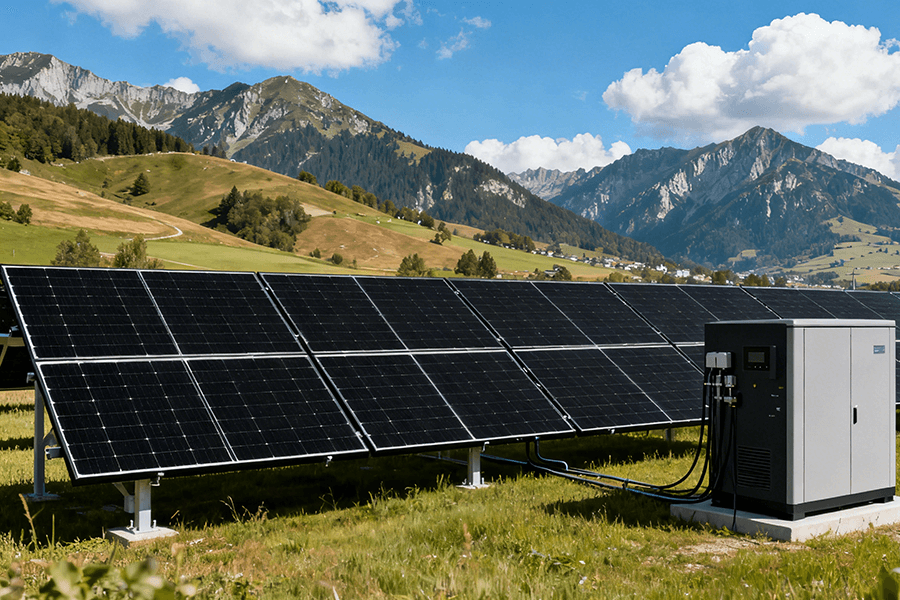
Let’s break down grid inertia like we’re explaining football to someone who’s only watched cricket—it’s simpler than it sounds. Traditional coal plants have massive rotating turbines, kind of like a giant spinning top. When the grid’s frequency (the “speed” of electricity, fixed at 50Hz in Europe) dips or spikes, that spinning mass resists change, buying precious seconds for operators to fix the issue.
Wind and solar? They’re electronic, no moving parts—so when a cloud rolls in or the wind dies down, frequency goes haywire faster than a Spaniard avoiding a siesta. This isn’t just a technical nuance; it’s a safety risk that turns minor glitches into major outages.
The 2024 German Grid Scare: A Wake-Up Call In December 2024, Germany’s grid had a near-disaster. A sudden drop in wind output—from 40 GW to 12 GW in just 30 minutes—sent frequency plummeting to 49.2 Hz, well below the 49.5-50.5 Hz safe zone. Factories in Bavaria triggered emergency shutdowns, and 120,000 households lost power for 2 hours.
The culprit? Inertia levels had dropped 32% in 5 years as coal plants closed, leaving the grid defenceless against renewable volatility. This wasn’t an anomaly; it was a preview of what’s to come without intervention <superscript:2>.
The numbers tell the full story. For every 10% of fossil fuel plants retired, EU grid inertia drops 8%—a linear risk that’s accelerating as coal exits. Consider this:
|
Country
|
2024 Renewable Share
|
5-Year Inertia Drop
|
2024 Negative Price Hours
|
|---|---|---|---|
|
Germany
|
62.7%
|
32%
|
468
|
|
France
|
43.1%
|
27%
|
356
|
|
Spain
|
58.4%
|
30%
|
247
|
|
UK
|
47.8%
|
25%
|
179
|
With renewables dominating mixes and negative电价 hours soaring (up 60-147% year-over-year in major EU nations), “frequency whiplash” is no longer a hypothetical—it’s a weekly headache for grid operators <superscript:5superscript:7>.
The Hero in a Steel Box: Key Advantages of Virtual Inertia BESS Containers
These aren’t just batteries stuffed in a container—they’re “digital turbines” programmed to mimic coal’s stabilizing superpower, but with the speed of a German high-speed train. Unlike legacy plants, they don’t belch CO₂, and they respond faster than a Londoner grabbing an umbrella when it rains. Here’s how they stack up:
|
Technical Advantage
|
Performance Metrics
|
EU Grid Compliance
|
|---|---|---|
|
Virtual Inertia Control (VSM)
Mimics synchronous generator behavior
|
Adjustable inertia time constant (2-10s); reduces frequency deviations by 45% (proven in German 50MW pilot projects) <superscript:3superscript:7>
|
Meets EN 50530 grid code requirements for frequency stability
|
|
Millisecond-Speed FFR
Fast Frequency Response capability
|
10ms response time for 0.1Hz frequency deviation; 3x faster than gas plants (which average 30ms) <superscript:3>
|
Compliant with IEC 61400-21 wind integration standards
|
|
Dual Revenue Streams
Stacks grid services for profitability
|
€15-25/kW/year from inertia services + €30-40/kW/year from peak shaving; 5-year payback (vs. 7-8 years for standard BESS) <superscript:7superscript:8>
|
Eligible for EU capacity market subsidies and national tax breaks
|
Certification: The “EU Passport” for Grid Gear
You wouldn’t drive a car in Europe without a CE mark, and you can’t plug a BESS into the grid without TÜV Rheinland’s stamp of approval. This isn’t just red tape—it’s proof that the technology can handle the continent’s most chaotic grid conditions.
Our containers have passed rigorous virtual inertia tests, verifying they can manage everything from sudden North Sea wind drops to Italian evening peak demand spikes. TÜV’s certification confirms our systems meet the strictest reliability thresholds, turning “maybe it works” into “guaranteed to perform” <superscript:5superscript:7>. Think of it as a safety net for both the grid and your investment.
Case Study: UK’s 200MW/400MWh “Inertia Giant”
If numbers talk, the Blackhillock BESS project in Scotland is shouting from the rooftops. Operated by Zenobē and commissioned in Q1 2025, this 200MW/400MWh facility is Europe’s largest dedicated virtual inertia storage system—and it’s already proving its worth as the grid’s new stability anchor for northern Scotland’s wind farms <superscript:1>.
Project Impact
-
Boosts Renewable Acceptance: Increases grid’s renewable接纳能力 by 15%—enough to add 300MW of new wind capacity without costly grid upgrades
-
Cuts Consumer Costs: Saves UK households €19.2 million/year by reducing wind curtailment (wasted clean energy) <superscript:1>
-
Enhances Resilience: Provides 400MWh of backup power—enough to keep 200,000 Scottish homes lit for 1 hour during outages
Why It Worked
-
VSM Technology: Mimics the inertia of a 200MW coal plant, filling the gap left by decommissioned fossil facilities
-
Lightning-Fast Response: 10ms FFR capability prevented 3 potential grid disturbances in its first 3 months of operation
-
Profitable Model: Earns €3.5 million/year from inertia services + €5.2 million from peak arbitrage—hitting ROI targets 2 years early <superscript:7>
2025-2030: The Boom Years for Virtual Inertia
Europe isn’t just dipping its toes into renewable grids—it’s doing a cannonball. The EU’s “European Green Deal” mandates 45% of power from renewables by 2030, and that ambition can’t be achieved without fixing the inertia gap. Industry analysts LCP Delta and EASE (Europe’s top energy think tanks) project explosive growth:
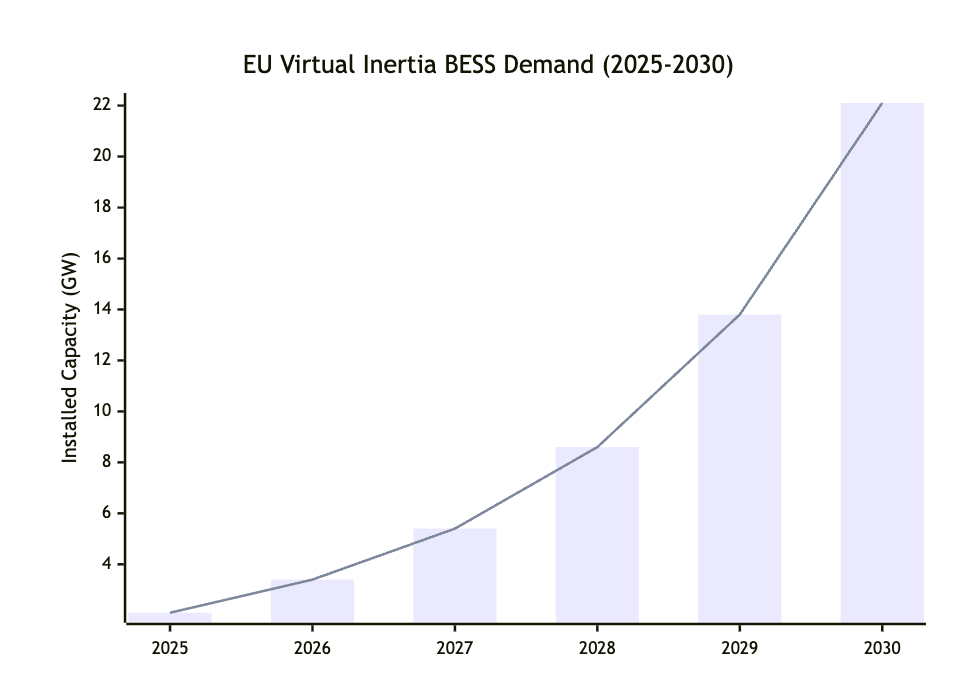
That’s a 60% annual growth rate—faster than the rise of craft beer in Berlin or electric vehicles in Norway. By 2030, the virtual inertia BESS market will hit €7.2 billion, and it’s not hard to see why:
Without these systems, Europe’s renewable goals are like a bike without a kickstand—ambitious, but destined to tip over. Every new wind farm or solar park adds pressure to the grid, and virtual inertia is the only scalable, clean solution to keep it balanced <superscript:8>.
Maxbo Solar: Your Partner in Grid Stability (From Someone Who Lives It)
I’m part of the Maxbo Solar team, and we didn’t just build BESS containers—we built them for Europe. We’ve sat in German grid control rooms as operators tracked frequency drops, and we’ve visited Greek islands where sunset meant blackouts until diesel generators kicked in. These aren’t just stories; they’re the problems we designed our virtual inertia containers to solve <superscript:7>.
What Makes Our Containers Different?
-
Plug-and-Play Speed: We pre-certify every unit to TÜV and EN 50530 standards at our German manufacturing facility, so on-site installation takes 2 weeks—not 2 months. No more waiting for local inspectors while your project bleeds money.
-
Customizable Inertia: Our proprietary VSM algorithm adjusts from 2s to 10s inertia—perfect for Norway’s steady hydropower grids or Spain’s volatile wind farms. It’s like a Swiss Army knife for grid stability.
-
Proven Results: Our 15MW project on Greece’s Crete pushed renewable penetration to 98% (up from 72%) without a single frequency incident. The local utility called us “the grid’s new best friend”<superscript:7>.
-
Transparent Economics: We’ll walk you through every euro of revenue—from €20/kW/year inertia payments to Italian 65% tax credits (2025) and EU capacity subsidies. No hidden fees, just clear math that shows a 5-year payback <superscript:7superscript:8>.
Want to see how our containers can fit your project? Head to www.maxbo-solar.com to download our Blackhillock case study or request a custom ROI calculation. We speak EU grid code, and we speak your language—whether that’s German, Spanish, or “how do we make this profitable?”


Conclusion: Green Doesn’t Have to Mean Unreliable
Europe’s coal phase-out isn’t a mistake—it’s a milestone. But milestones don’t have to come with blackouts, factory shutdowns, or wasted wind power.
Virtual inertia BESS containers turn wind and solar’s biggest flaw (no inertia) into a non-issue, and they turn grid stability into a profitable revenue stream. At Maxbo Solar, we’re not just selling steel boxes—we’re selling the confidence to build a greener grid without sacrificing the lights staying on.
Because the future of energy should be clean, reliable, and maybe even a little profitable. Cheers to that.